Here's some quick technique and theory tips to get you started. When you ready to advance further, you will find much more detailed information on these subjects in the complete members site, complete with additional photos and downloadable sound files.
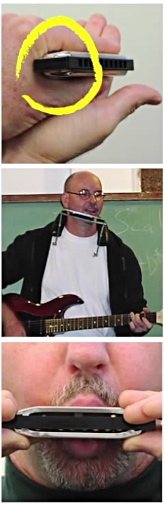
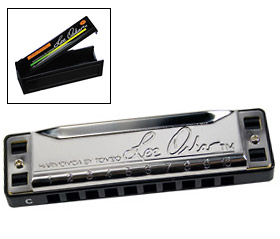
- Holding the Harmonica/Playing Single Notes- For now, merely hold it on the ends with the numbers imprinted over the holes facing up -- hole number "1" to the left and hole number "10" to the right (low notes are to the left like a piano). If you are ready to begin serious work on your first playing technique, you should start with the single note technique so that your songs and riffs will come out clear, distinct, and recognizable. After a few weeks, when you are feeling fairly comfortable and consistent with the single notes, you can then work on the more sophisticated method of holding/hand effects.

Beginning method of holding -- low notes (hole number "1") to the left.
- Breathing- There is no need at this point to be overly concerned with breathing technique. Do avoid pushing and pulling (sucking) the air with your lips. Stay relaxed, and when you blow (exhale), try to focus the air through the harmonica and not just into it. On the draw notes (inhale), concentrate on bringing the air through the harmonica and through your mouth, deep into your lungs, past your chest.
Problems with hole 2 draw (and others)- It is normal for new players to have problems with hole 2 draw, other low draw holes, and the high draw notes. In 99% of the cases, it is the playing technique and not a bad harmonica at fault. After a month or so, take a look at the Breathing technique section for more detailed information if you are still having problems. If you stick with songs that are played between holes 4 and 7, you should not experience too much trouble with the blows or draws.
- Quick Tips:
- Good posture- When playing and practicing, stand erect with your head up, back straight, and body relaxed.
- Knock out excess saliva- Get in the habit of frequently rapping the harmonica (mouthpiece side down) against your leg or palm to knock out the excess saliva and condensation from your breath that accumulates inside the harmonica.
- Lick your lips and the mouthpiece If you find your lips sticking to the harmonica when you slide or move from hole to hole, lick your lips and the mouthpiece part of the harmonica before playing. Saliva works best for this purpose, you do not need additional lubricants. If fact, they tend to cause more problems than they will solve.
- Move the harmonica, keep head still- Attempt to move the harmonica and not your head when moving from hole to hole. Use a mirror to check.
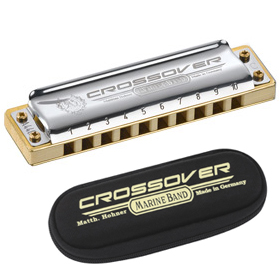
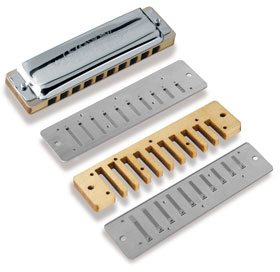
- Do you have the right harmonica for these lessons?- Don't try to learn to bend notes or play blues without the proper type of harmonica. See the 1. Which Harmonica do I need? page for more information.
- Practice 2 or 3 times a day- 15 to 30 minutes of practice a day is a good amount of time if you can stick with it. You may find it easier to practice for 10 minutes 2 or 3 times a day and build up your endurance (it won't take too long). It's normal to get winded and feel muscle fatigue in your lips and hands for the first few months.
- Listen to harmonica playing- As your skill level continues to increase, try to copy or mimic the sounds and solos of your favorite harmonica players. Visit the "Recommended For Beginners" music CDs section of our Harmonica Store for suggestions on players and CDs to listen to (use the "Recommended Accessories" link below for more details). The CDs: Song Keys section will tell you which is the correct key of harmonica for many favorite albums.
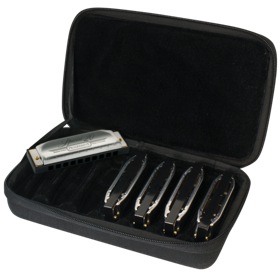
- Maintenance and Repairs- At this point, you don't need to do much besides knocking out excess saliva, wiping your harmonica off, and placing it back in it's original case when finished, to keep it in good working order. Visit the Repairs & Maintenance section for more information.
- Want more quick tips?- For many more tips, visit the One Liner Tips page. Also, take a look at our "When In Doubt..." page for some general jamming tips.
- Simple Song Playing vs. Basic Jamming (1st Position vs. 2nd Position)- For simple song playing and melodies we play in what is called 1st Position (Straight Harp). By doing so, we will play songs on our key of "C" harmonica, in the key of "C", by mostly blowing in the middle part of the harmonica. Hole 4 blow is a typical starting point and home base for 1st position. You'll notice that the blow notes make a different sound than the draw notes do (as evidenced by the 1st position Major Scale).
For basic blues, rock, and country jamming, we play in what is called 2nd Position (Cross Harp). By doing so, we will play our key of "C" harmonica in the key of "G", by mostly drawing (inhaling) at the low end of the harmonica. Hole 3 blow (or 2 draw) is a good starting point and home base for 2nd position blues jamming. Visit the Basic Blues Improv section for information on intermediate level jamming.
- The complete instruction and information sections- are available to full members at Harmonica Lessons.com. In addition to the beginning instruction with Lesson Plans, you have access to in-depth technique instruction, over 100 songs & tabs, Discussion Forums, and more. Click here for more info.
What else do you need besides a good harmonica to get started? Not much really, but jump to the next page to see what some of the 3. Recommended Extras and accessories might be.
|